Sustainable Services

Adobe Construction

One of the Oldest Construction Techniques — yet can fulfill Modern Human Housing Requirements.

Adobe is a building material made of organic materials such as earth, clay, straw, and water. Adobe bricks are traditionally made in open cast molds and left to sun-dry rather than being kiln-fired. They are laid using earth mortar and smoothed down before a clay render is applied as a surface coating.

Adobe bricks are fire-resistant, flexible, and durable. They provide sufficient thermal mass for good energy efficiency and sound insulation. Adobe construction spread throughout warm, dry climates and dates as far back as the 8th century B.C.

The largest adobe building in the world is The Great Mosque at Djenné in Mali — built in 1907 with walls as thick as 24 inches, arches 45 feet high, and covering 62,500 square feet.
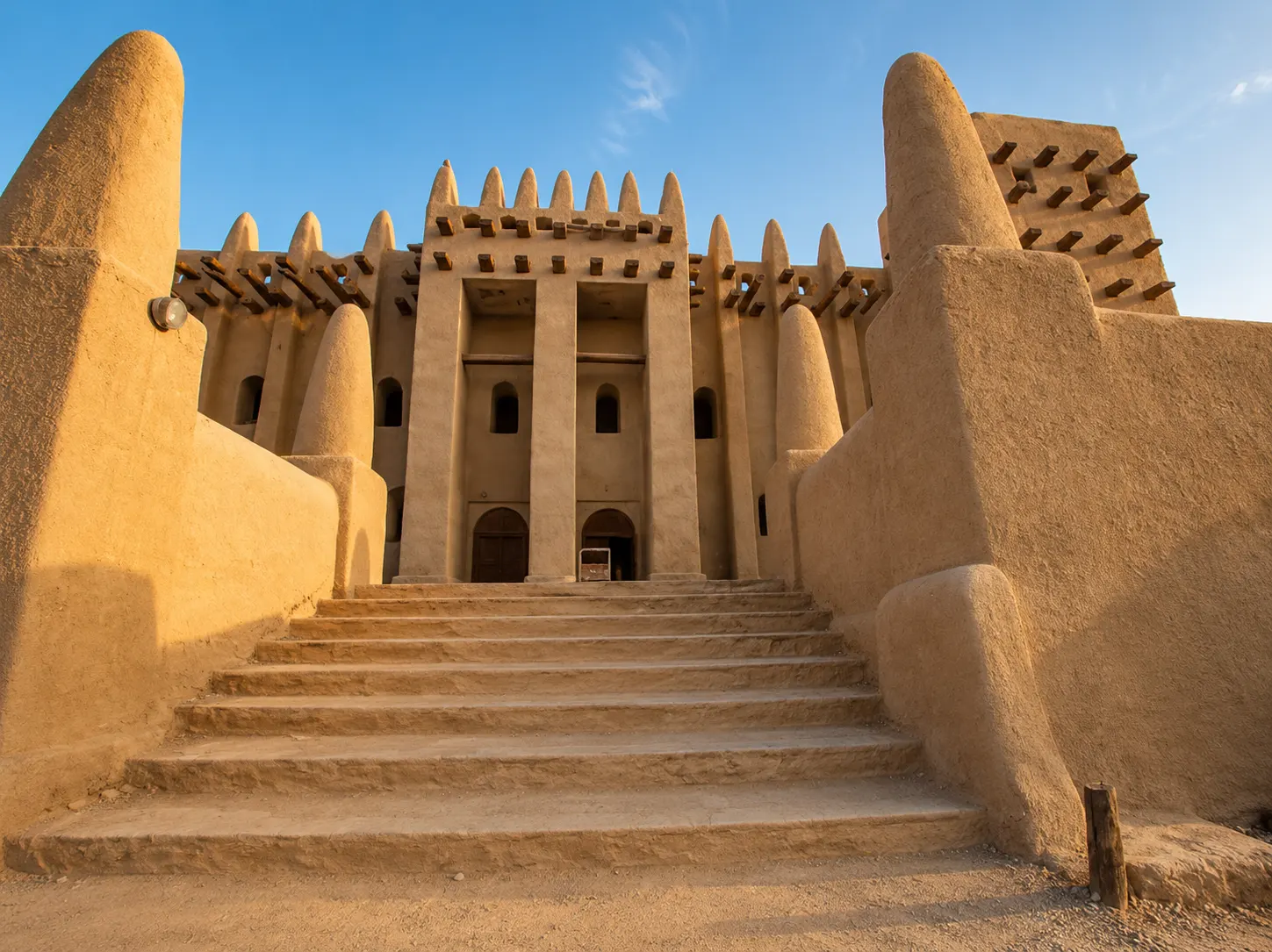
Adobe Construction

How to Make Adobe Bricks

Mix sand and clay with water, then add straw — this helps the mud shrink into uniform brick shapes as it dries.
Put the mud mixture into wooden forms and level by hand. Make them any size or shape, but easy to move by hand.
Remove bricks from the forms and lay them on a straw or grass-covered surface in the sun.
After a few days of drying, set bricks on their edges for at least four weeks of air-drying.

Materials Required

Earth (Soil) — Use rough, coarse sand with varied particle sizes. Clay acts as a binder. Pure clay cannot be used alone as it expands when wet and contracts when dry — it needs aggregate and straw for stability.
Straw — Acts as natural rebar, adding tensile and shear strength. Use fresh straw with long strands (6–12 inches). Check bales from the inside for mold or mildew.
Water — Regular tap water works fine. If collecting from open water, remove any leaves or organic matter first.

Dimensions of Adobe Bricks

Standard adobe bricks are typically 10 × 4 × 14 inches. Many older buildings contain adobe bricks with dimensions up to 6 × 12 × 24 inches.

How to Build an Adobe House — Step by Step

Step 1 — Site Preparation — Clear all grass, plants, and organic matter. Do not use topsoil as it contains impurities. Compress the site, then mark wall layout using limestone powder.
Step 2 — Foundation — Dig a trench of 1–2ft beneath the walls on a slope for drainage. Add a plastic sheet, then fill with gravel or brick ballast up to ground level. Adobe walls are load-bearing with 2ft thickness — no special foundation needed for single storey.
Step 3 — Walls — Lay adobe bricks with mud mortar just like conventional masonry. Build thick walls — 10 inches (25.4cm) or more — for strength, thermal insulation, and comfort.
Step 4 — Windows, Doors & Ventilators — Place wooden door and window frames first, then build adobe walls around them. Use solid timber headers at least 6" thick above openings. Place ventilators at the top of walls — the roof acts as lintel.
Step 5 — Roofing — Use a wooden frame or bamboo roof for single storey. Concrete roofs require strong foundations and a bond beam. Keep the roof as lightweight as possible.
Step 6 — Plastering — Protect adobe bricks from rain using mud plaster, lime plaster, or whitewash. Mud plaster bonds best to adobe. Lime plaster is harder but less flexible. Whitewash is an ancient sealer containing clay, water, and gypsum.
Step 7 — Flooring — Compact the ground, apply fine clay and water plaster, then coat with linseed oil for a smooth finished surface.