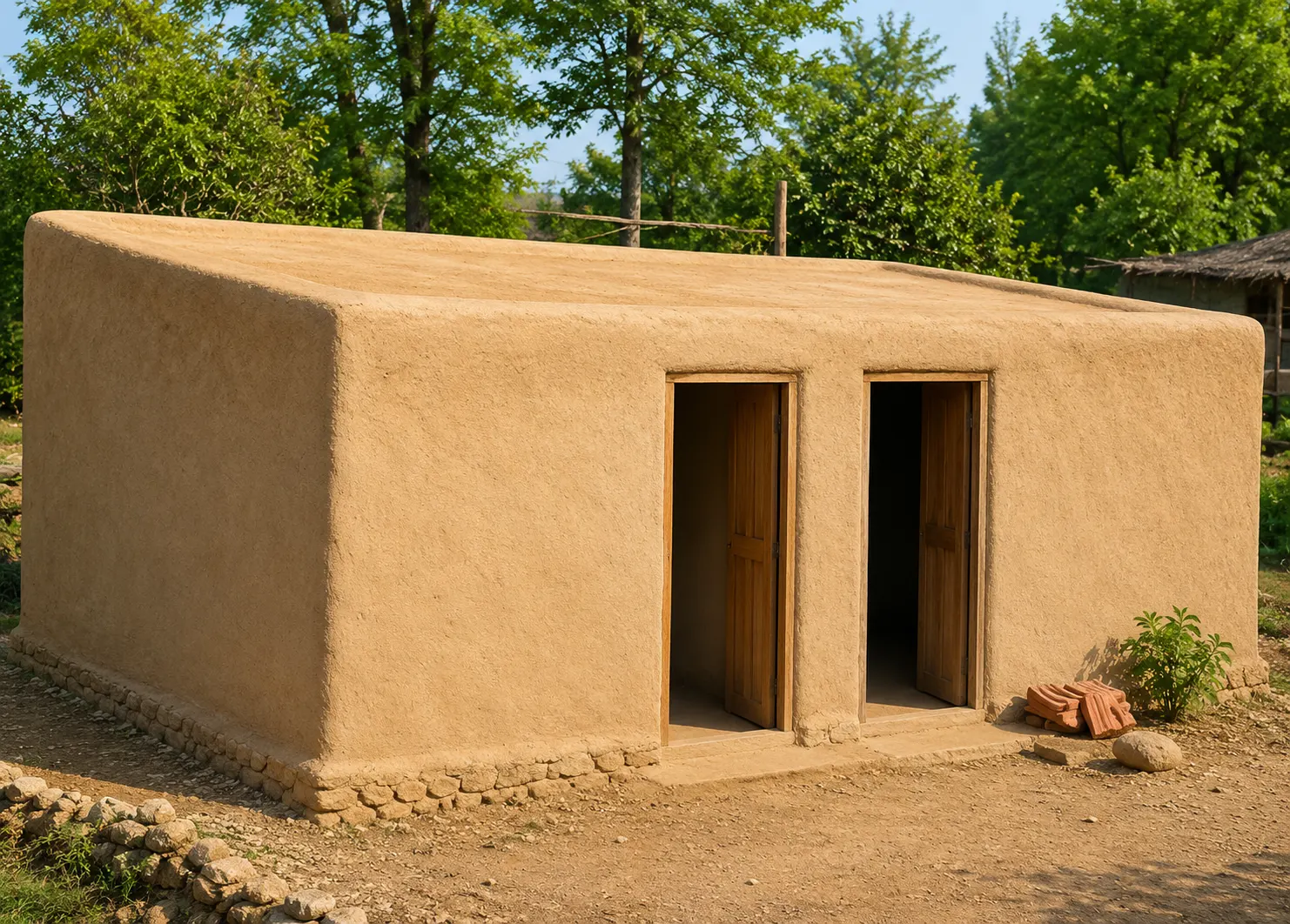
Cob is a mixture of natural ingredients such as sand, clay, straw, and water — mixed in suitable proportions so the whole unit acts as a single solid structure. Soil acts as the compression member and straw behaves as the tensile member.
Soil from the earth has proven to be a very suitable building material across all world climates due to its ability to regulate indoor temperatures. Earth has low thermal conductivity and high thermal mass — an earthen building stays cool in summer and warm in winter with no air conditioning.
Cob has very high thermal insulation due to its thick walls (18–24"), making cob structures cool during summers and warm during winters.
The materials required are not expensive — most can be found right beneath your feet. You only need to buy a couple of things from the market.
Earth (Soil) — Use rough, coarse sand with varied particle sizes. Clay acts as a binder holding the aggregate together. Pure clay alone cannot be used as it expands when wet and contracts when dry — it needs aggregate and straw for stability.
Straw — Acts as natural rebar, adding tensile and shear strength. Use fresh straw with long strands (6–12 inches), not brittle or moldy. Examine bales from the inside to check for mold or mildew.
Water — Regular water from water lines is fine. If collecting from open water, remove any leaves or organic matter first.
Step 1 — Site Preparation — Clear all grass, plants, and organic matter. Do not use topsoil as it has impurities. Compress the site, then mark wall layout using limestone powder.
Step 2 — Foundation — Options include trench foundations (2ft×2ft trench filled with 3 layers of compacted gravel, plus 1.5ft stem wall) or concrete foundations (footers below ground + stem wall 1.5–2ft above ground as moisture break).
Step 3 — Mixing Cob — Mix 2 parts sand, 1 part clay, straw, and a little water on a tarp using bare feet. Keep dry ingredients in the center of the tarp and mix thoroughly before use.
Step 4 — Building Walls — Walls are built in layers directly on the foundation — thick at the base (24") and narrower at top (18"). Build 2–3ft per layer, let dry overnight before the next layer. Poke holes at the top of each layer to integrate with the next.
Step 5 — Windows, Doors & Ventilators — Place wooden door and window frames first, then build cob walls around them. Use a solid timber header at least 6" thick for spanning above openings. Place ventilators at the top of walls — no frame needed as the roof acts as lintel.
Step 6 — Roofing — Options include a wooden frame roof (beams, purlins, rubber membrane) or a bamboo roof (bamboo + reed grass + plastic sheet + mud plaster). Extend the roof 2ft beyond all walls to protect cob from rain.
Step 7 — Plastering — Optional but recommended in high-rainfall regions. Limestone plaster or epoxy finish can be used. Cob itself provides a fine natural finish.
Step 8 — Flooring — Compact the ground, apply fine clay and water plaster, then coat with linseed oil for a smooth, finished surface.