Sustainable Services

Bamboo Construction

One of the Oldest Construction Materials — yet can fulfill Modern Requirements.

Bamboo is a strong, fast-growing, and sustainable material. In modern times, it can be an aesthetically pleasing and low-cost alternative to more conventional materials. Bamboo has high compressive strength and low weight, making it one of the most used building materials as support for concrete.

Bamboo's resilience coupled with its lightweight makes it an ideal material for housing in disaster-prone and earthquake-prone areas. It can withstand repetitive loadings, absorb more energy, and show more considerable deflections before collapsing — safer under Earth tremors.

Bamboos are one of the fastest-growing plants in the world — three times faster than most other species. They are a renewable and extremely versatile resource with multi-purpose usage. Bamboo has been used as a construction material since the dawn of time.
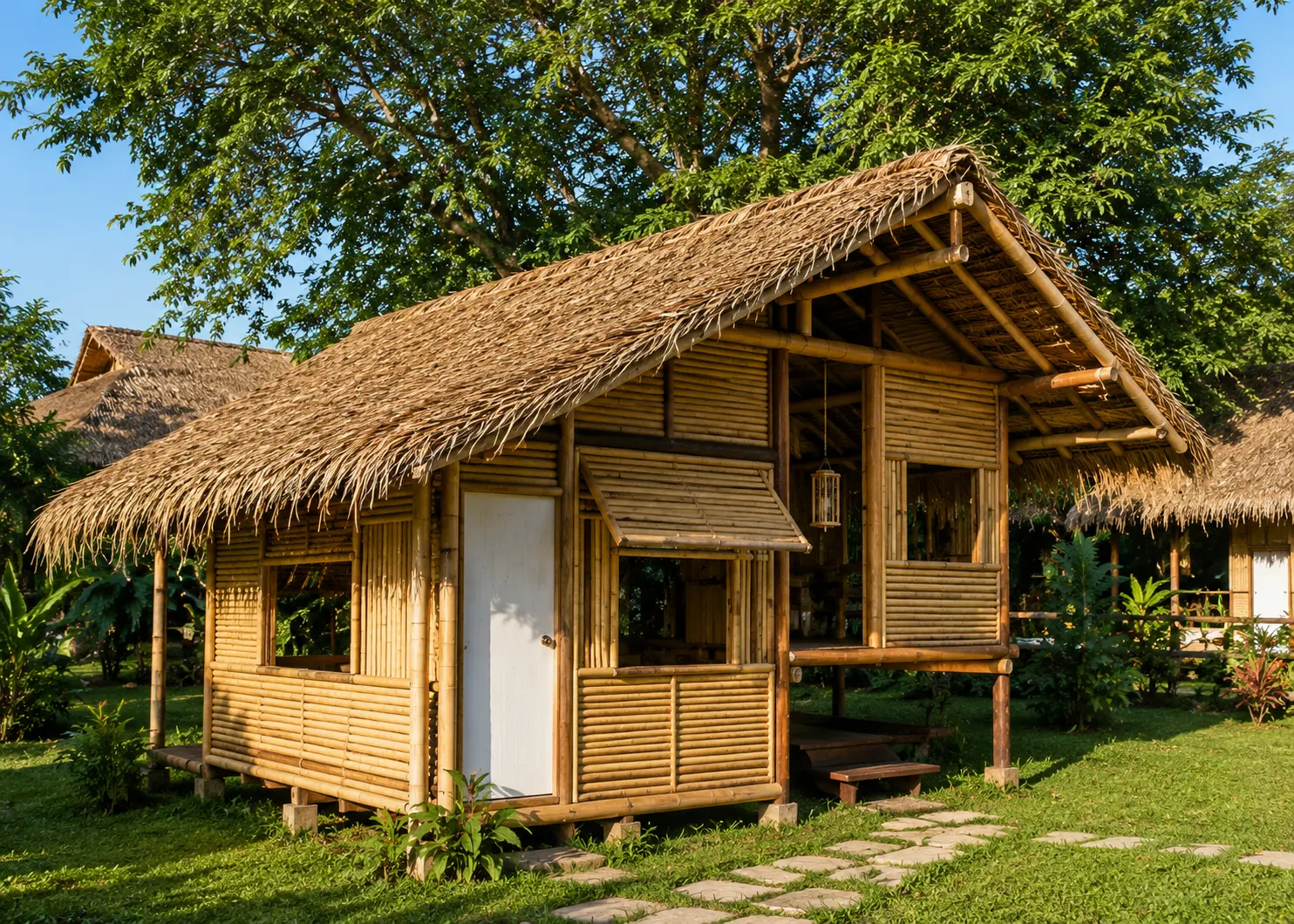
Bamboo Construction

Bamboo as a Construction Material

Bamboo is used for the construction of scaffolding, bridges, structures, and houses. For bamboo to be used as a building material, it must be worked on to create the desired shape, bend, and length. Utilization of bamboo for construction is achieved by a structural frame technique related to timber frame design — floor, walls, and roof interconnected for overall stability.

Preservation — A thorough treatment with Borax and Boric acid is required to protect bamboo against insects and rot before use.
Walls — Posts and beams are the main elements constructed with bamboo to provide a structural framework. Infill between framing elements adds strength and stability.
Roofing — Bamboo provides ample sturdiness, is light-weighted, and easy to install. Bamboo roofs encompass purlins, rafters, and trusses.
Scaffolding — Due to its load-bearing properties, bamboo is highly endorsed for scaffolding even for tall structures.

What Makes Bamboo One of the Best Construction Materials

Tensile Strength — Bamboo has higher tensile strength than steel because its fibers run axially.
Fire Resistance — Bamboo can withstand temperatures up to 4000°C due to high silicate acid and water content.
Elasticity — Widely preferred in earthquake-prone regions due to its elastic features.
Low Weight — Easily transported and installed, making construction faster and more economical.
Health Safe — Unlike cement and asbestos, bamboo poses no danger to health.
Cost Effective — Easy to use and especially in great demand in earthquake-prone areas.

How to Construct a Bamboo House

With proper designing, perseverance, and care, a low-cost, environment-friendly bamboo house can last as long as any other structure. Below is a step-by-step guide.

Step 1 — Site Preparation — Remove 3"–6" of topsoil, clear all organic matter, compress the site, and transfer wall layout using limestone powder.
Step 2 — Foundation — Dig 1ft trench beneath walls, compact, pour lime-sand-aggregate mixture (1:4:8), and build stem wall of mud bricks to 1.6ft height.
Step 3 — Walls — Build orthogonal panels of diagonally braced bamboo walls with window and door openings, then fit with thatch and plaster.
Step 4 — Roof — Bolt roofing panels to wall panels. Place diagonal bamboo purlins and green thatch roof to prevent rainwater entry and allow airflow.
Step 5 — Windows & Doors — Separate wall panels are built for windows and doors with a framework fitted into the main wall structure.
Step 6 — Plastering — Apply lime plaster (1:3 lime:sand) or mud plaster (1:4 straw:soil) in 2–4 coats for insulation and finish.
Step 7 — Flooring — Compact the ground, apply fine clay and water plaster, then coat with linseed oil for a smooth finished surface.