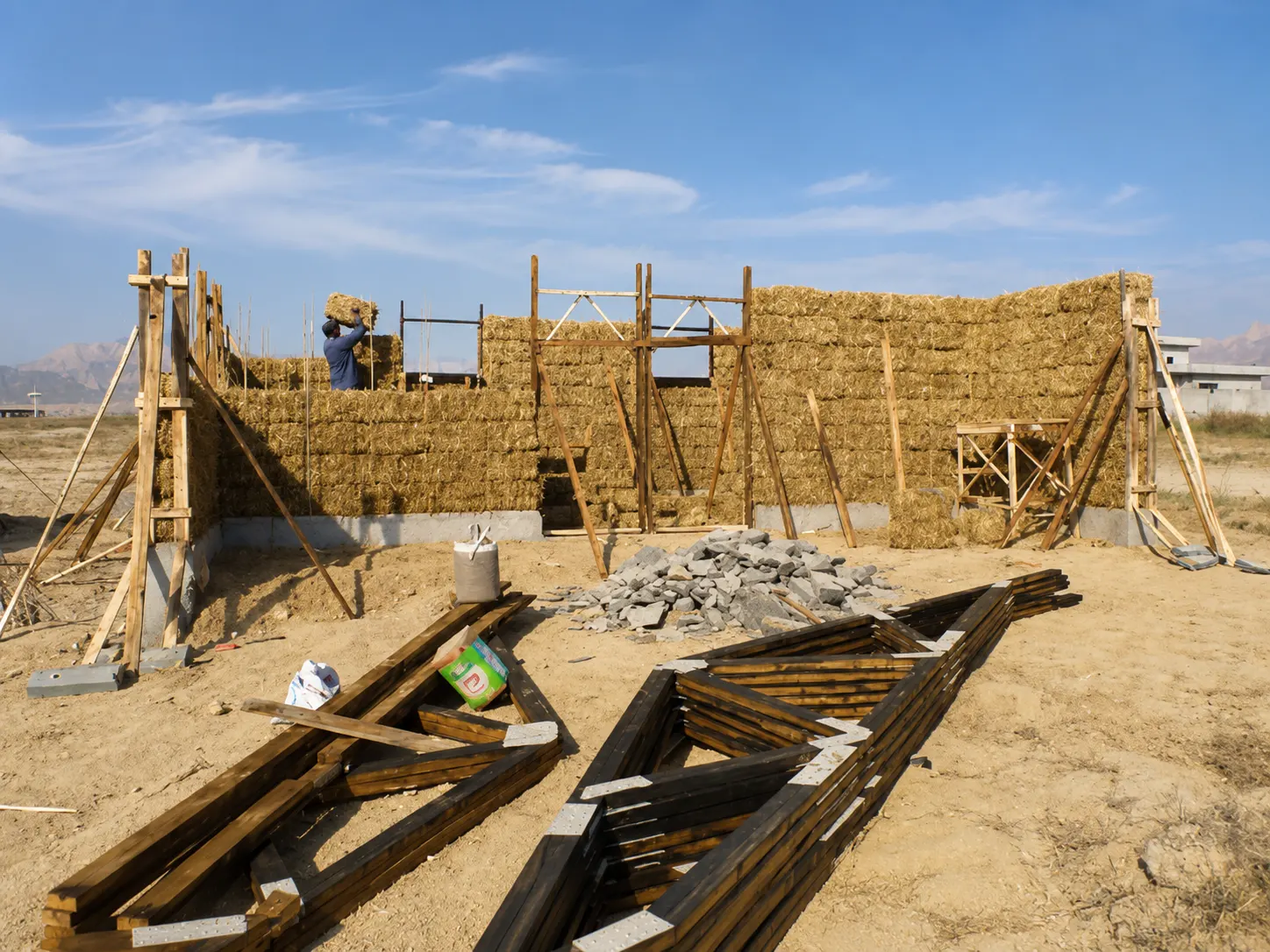
Straw bales construction is a building method that uses bales of straw as structural elements and/or building insulation. Straw has been used for centuries for thatch roofing and mixed with earth for cob walls. Straw is the springy tubular stalk of grasses such as wheat and rice — high in tensile strength.
Strawbale walls are rendered and surprisingly resistant to fire, pests, and decay. Greenhouse gas emissions associated with straw bales are very low — one ton of concrete requires more than 50 times the energy in its manufacture than straw.
The structural capability of straw bales is surprisingly good. In the loadbearing Nebraska style, walls of up to 3 stories have been constructed.
Loadbearing Method (Nebraska Style) — The bales themselves take the weight of the roof with no other structural framework. Placed like giant building blocks, pinned to foundations and each other with coppiced hazel, with a wooden roof plate on top.
Lightweight Frame & Loadbearing — A very lightweight timber framework combined with straw walls. The straw is an essential part of the structural integrity — working together with the timber to carry the load of floors and roofs.
Post and Beam / Timber Frame — The roof weight is carried by wood, steel, or concrete framework. Bales act simply as insulation blocks between posts — preferred by architects as it relies on established building methods.
Hybrid Design — A combination of the above techniques. Bales are stacked in vertical columns with cement mortar forming posts between each stack, then rendered inside and out.
Bales should be dry, well compacted with tight strings, and uniform in size with virtually no seed heads.
Moisture content must not exceed 15% (wet weight basis). Protect bales from dampness throughout the building process.
Bales should be roughly twice as long as they are wide — the larger the better. Strings must be very tight.
Step 1 — Site Preparation — Clear all grass, plants, and organic matter. Do not use topsoil as it has impurities. Compress the site, then mark wall layout using limestone powder.
Step 2 — Foundation — Use rubble trench foundations (2ft×2ft trench with 3 layers of compacted gravel) or earthbag foundations (polypropylene bags filled with soil/sand). A stem wall of stones at 2–3ft height is required. Straw bale walls must never touch ground level.
Step 3 — Walls — Can be loadbearing or non-loadbearing. Plaster strawbale walls in two layers of 1.5" thickness to protect from moisture. For loadbearing walls, stack bales to roof height and place a wooden header on top. For non-loadbearing, fit bales between a timber frame.
Step 4 — Windows, Doors & Ventilators — Place wooden door and window frames first, then build straw bale walls around them. Place ventilators at the top of walls — no frame needed as the roof acts as lintel.
Step 5 — Roofing — Spread loads evenly around perimeter walls. Straw houses need a large roof overhang (about 500mm / 20") to protect walls from rain — especially important in wet climates.
Step 6 — Plastering — Use breathable lime-based plaster (1:3 lime:sand, 2–4 coats) or clay plaster with fiberglass/plastic mesh reinforcement. Trim the straw surface short before plastering. Never use metal mesh with clay plaster as moisture causes rusting.
Step 7 — Flooring — Compact the ground, apply fine clay and water plaster, then coat with linseed oil for a smooth finished surface.