Sustainable Services

Compressed Earth Block Construction

The modern descendant of the moulded earth block — more commonly known as Adobe Blocks.

Compressed Earth Blocks (CEB) are construction materials made using damp soil under high pressure to form blocks — similar to adobe bricks but made from an earthen mixture compacted by machine. After compaction, they are cured for one to two days.

CEBs are made in-situ, reducing carbon footprint and manufacturing costs — about 40% cheaper than conventional clay bricks. Due to their thermal mass quality, CEBs save 10–15% on cooling and heating costs. No chemicals are used, so they release no harmful or toxic gases.

CEBs are approved construction materials widely used in France, the UK, Germany, and many other countries. Stabilized CEBs are made by adding 5–7% Portland cement to the earthen mixture.
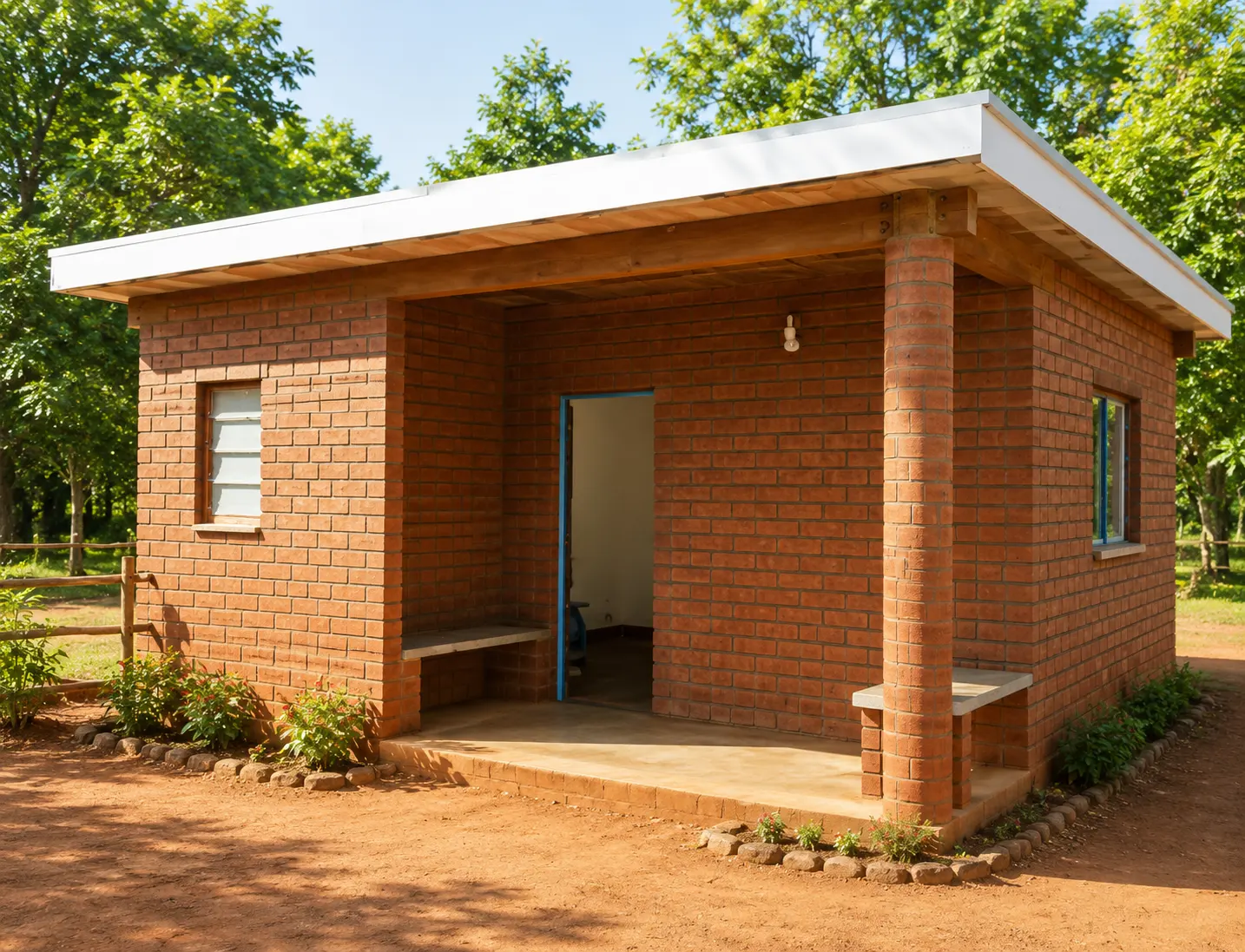
Compressed Earth Block Construction

Types of Compressed Earth Blocks

Ordinary Compressed Earth Blocks — Simple blocks without grooves or joints, laid using mud mortar. Straightforward to produce and use.
Interlocking Compressed Earth Blocks (ICEB) — Have male and female appendages that make them easy to stack in line, with holes allowing both vertical and horizontal reinforcement. More structurally versatile than ordinary blocks.

How to Make Interlocking Compressed Earth Blocks

A combination of soils is typically used to achieve the desired strength. On-site tests should confirm a minimum of 15–30% clay content in the soil mixture.

Add cement to the earthen mixture and mix thoroughly.
Add a little water — the mixture should be damp enough to clamp in the palm of the hand.
Place the mixture into the CEB machine which compresses it into blocks.
Dry and cure the blocks for a minimum of 2 days before use.

Block Sizes

External & Boundary Walls — Nominal size: 16 in × 6 in × 5 in
Partition Walls — Nominal size: 9 in × 4 in × 3 in

How to Build a CEB House — Step by Step

Step 1 — Site Preparation — Clear all grass, plants, and organic matter. Do not use topsoil as it contains impurities. Compress the site, then mark wall layout using limestone powder.
Step 2 — Foundation — CEB walls are load-bearing with high thermal mass. A simple single-storey building does not require special foundations. Use brick ballast, gravel, or rubble trench foundations.
Step 3 — Walls — Place CEBs according to their male and female interlocking parts. Window and door frames must be set in place during wall construction.
Step 4 — Windows, Doors & Ventilators — Construction is similar to ordinary brick masonry. For interlocking blocks, carefully align the male and female sides. Include a header or lintel extending 1ft beyond the width of each window and door opening.
Step 5 — Roofing — A simple wooden roofing system is used. Include a long sloping overhang on the south face to shade windows in summer and capture passive solar energy. Extend all roof edges at least 1ft beyond the walls to direct water away from the foundation.
Step 6 — Plastering — Stabilized CEBs generally do not need plastering. In heavy rainfall regions, apply lime plaster in 2 coats of 1.5" thickness each.
Step 7 — Flooring — Compact the ground, apply fine clay and water plaster, then coat with linseed oil for a smooth finished surface.