Sustainable Services

Earthen Flooring

The earthen floor feels gentler to your bones and natural to your feet — as if you were walking outdoors.

For most of human history, people have lived in durable, comfortable buildings made from natural materials such as soil, sand, rocks, and fiber. A quarter to a third of the world's population today still lives in houses built partially or entirely of earth.

Earthen floors add a great earthy touch to any sustainable home — whether a cob house or a conventional stick frame home. They have more give than concrete or tile, making them more comfortable and easier on your feet. Earthen floors are durable and can last a very long time.

An earthen floor is typically comprised of 5 layers: a waterproof membrane, tamped gravel (optional), compacted road base (sand, clay, and gravel), two layers of the final floor mix (sand, clay, and chopped straw), and sealing layers.
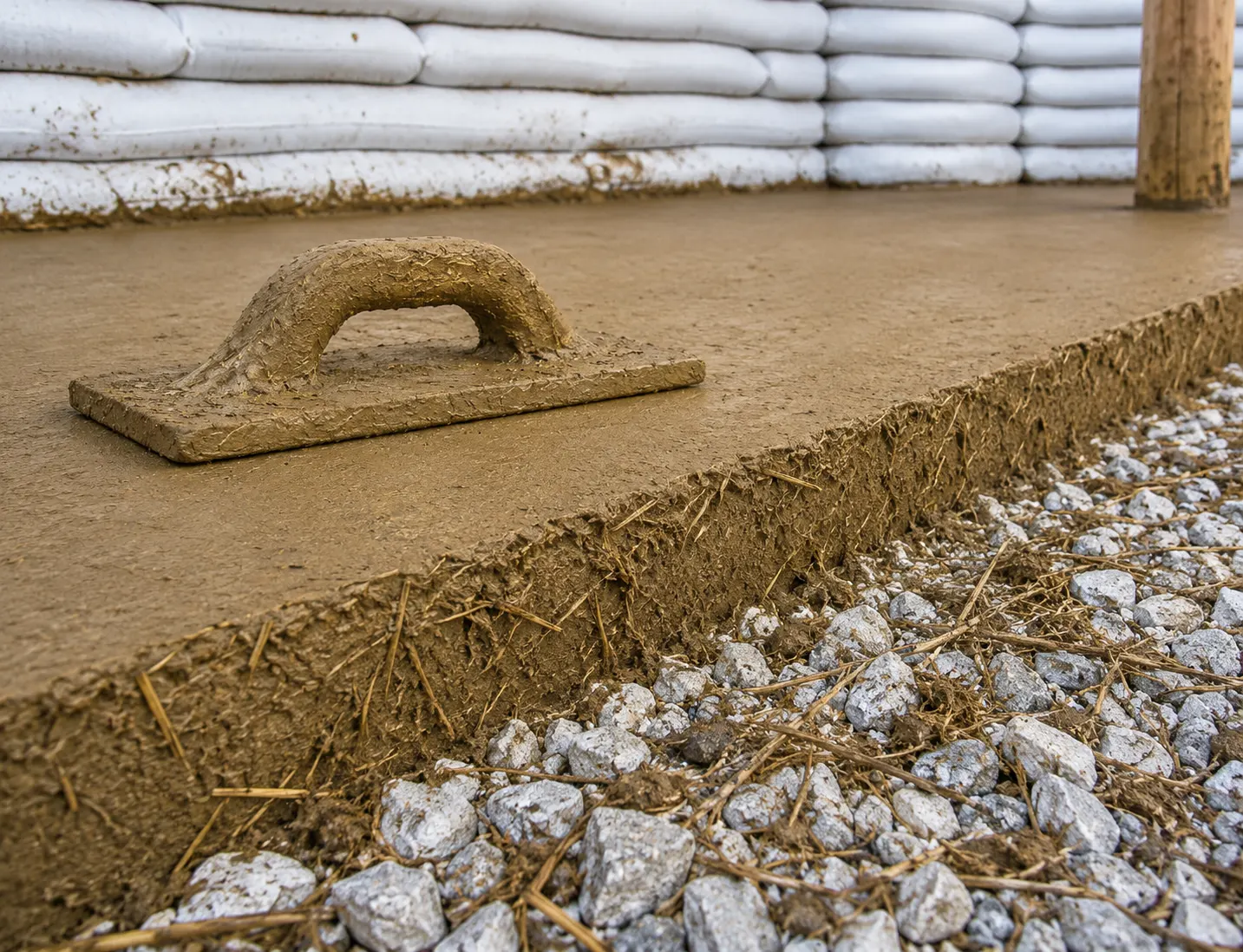
Earthen Flooring

Preparation of Floor

The floor must rest on solid, compacted ground — free of topsoil and organic matter, which continues to decompose and shrink over time, creating voids below the floor. The floor should also be free from cracks to prevent leakage or seepage. For earthen plaster, use compacted road base and a layer of gravel as the solid ground base.

Types of Earthen Flooring

Lime Mud Floor — Prepared using slaked lime, screened mud, and straw bale in a dry ratio of 1:3:1. Applied in two coats — a base coat of 1.5" and a final coat of 1.5" after the base dries for one day. The final coat is dried for a day and cured for a week before sealing. Best laid on lime concrete (ratio 1:3:6 — slaked lime, clay, sand).
Lime & Pozzolana (Brick Dust) Floor — Used in washrooms, kitchens, and areas prone to water leakage. Brick dust (pozzolana), slaked lime, and mud are mixed in ratio 1:1:4 with water. The floor is laid on a slope toward a drainage pipe. The base coat can be mud-lime or lime-pozzolana plaster, but the finish coat must be lime-pozzolana plaster.
Mud Earthen Floor — A simple combination of clay (15–20%), sand (80–85%), and straw for tensile strength and crack reduction. A jar test can determine clay content. Most earthen floors are laid over tamped gravel or cob/adobe subfloor. The finished layer is 0.5–2 inches thick and sealed with drying oil once dry.

Sealing Coats

Sealing coats are applied after the earthen floor has fully dried. Boiled linseed oil is the most common sealer — it is absorbed into the dry earth mix and polymerizes as it dries, binding the earth together and creating a hard, water-resistant surface.

Repair any cracks before applying sealer. Apply the first coat of boiled linseed oil and allow to dry for 7 days.
Apply a second coat after 7 days and let dry. Typically 2–3 coats are sufficient. The first two coats must be pure linseed oil — subsequent coats can be mixed with a suitable solvent.
Do not leave puddled oil on the floor — clean immediately with a clean rag. Oil can be applied with a brush, paint roller, or rags.
Optional: lightly sand the floor after oil has cured for a smoother finish, then apply a floor wax (perilla oil or floor wax) for added durability and shine. Buff with an electric buffer after drying to remove excess wax.