Sustainable Services

Earth-Based Construction Techniques

Traditional Building Methods for Modern Sustainable Housing. Earth-based construction is one of the oldest and most sustainable ways of building homes. For thousands of years, people have used natural materials such as soil, clay, sand, straw, and water to construct durable, energy-efficient, and environmentally friendly buildings.

Technique 1

Building with COB

One of the Oldest Construction Techniques — yet can fulfill Modern Human Housing Requirements.

Cob is a traditional earth-building technique that combines sand, clay, straw, and water into a single monolithic mass. Unlike adobe, cob is not made into bricks — the wet mixture is placed directly by hand in layers to create continuous load-bearing walls.

Cob buildings are well known for their thick walls, excellent thermal mass, natural insulation, and flexibility in creating organic architectural forms. Earth has low thermal conductivity and high thermal mass — an earthen building stays cool in summer and warm in winter with no air conditioning.

Cob has very high thermal insulation due to its thick walls (18–24"), making cob structures comfortable throughout the year without any artificial heating or cooling systems.
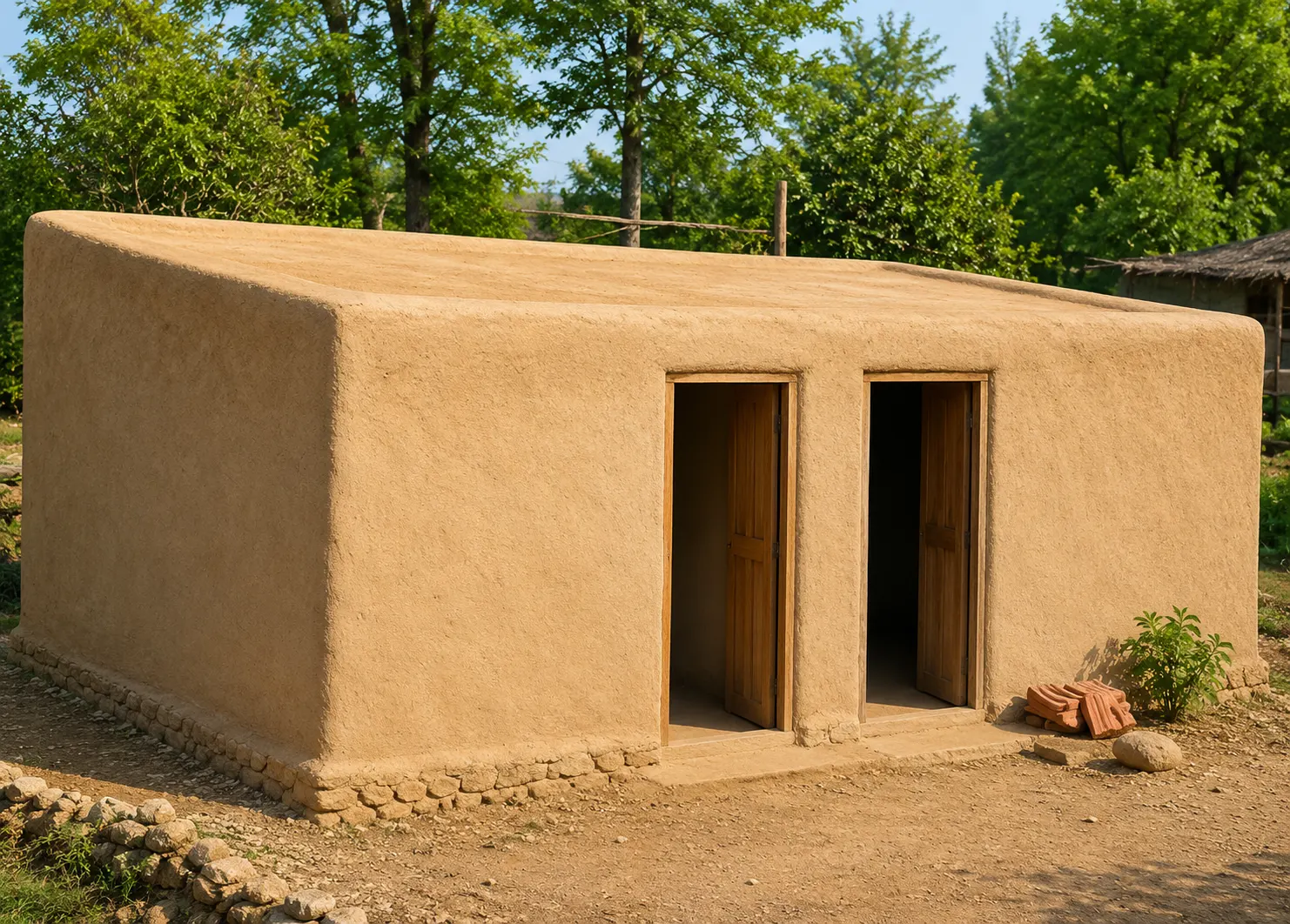
Building with COB

Materials Required

The materials required are not expensive — most can be found right beneath your feet.
Earth (Soil) — Use rough, coarse sand with varied particle sizes. Clay acts as a binder holding the aggregate together. Pure clay alone cannot be used as it expands when wet and contracts when dry.
Clay — Acts as the binder that holds all materials together into a solid mass.
Sand — Provides structural strength and prevents excessive cracking during drying.
Straw — Acts as natural rebar, adding tensile and shear strength. Use fresh straw with long strands (6–12 inches), not brittle or moldy.
Water — Regular water from water lines is fine. If collecting from open water, remove any leaves or organic matter first.

Typical Mixing Ratio

60–70% Sand
20–30% Clay
Straw with long fibers
Water as needed

Construction Process — Step by Step

Step 1 — Site Preparation — Clear all grass, plants, and organic matter. Do not use topsoil as it has impurities. Compress the site, then mark wall layout using limestone powder.
Step 2 — Foundation — Options include trench foundations (2ft×2ft trench filled with 3 layers of compacted gravel, plus 1.5ft stem wall) or concrete foundations (footers below ground + stem wall 1.5–2ft above ground as moisture break).
Step 3 — Mixing Cob — Mix 2 parts sand, 1 part clay, straw, and a little water on a tarp using bare feet. Keep dry ingredients in the center of the tarp and mix thoroughly before use.
Step 4 — Wall Construction — Walls are built in layers directly on the foundation — thick at the base (24") and narrower at top (18"). Build 2–3ft per layer, let dry overnight before the next layer. Poke holes at the top of each layer to integrate with the next.
Step 5 — Doors, Windows & Ventilators — Place wooden door and window frames first, then build cob walls around them. Use a solid timber header at least 6" thick for spanning above openings.
Step 6 — Roofing — Options include a wooden frame roof (beams, purlins, rubber membrane) or a bamboo roof (bamboo + reed grass + plastic sheet + mud plaster). Extend the roof 2ft beyond all walls to protect cob from rain.
Step 7 — Plastering — Optional but recommended in high-rainfall regions. Limestone plaster or epoxy finish can be used. Cob itself provides a fine natural finish.
Step 8 — Flooring — Compact the ground, apply fine clay and water plaster, then coat with linseed oil for a smooth, finished surface.

Technique 2

Adobe Construction

A Time-Tested Earth Building Method — Durable, Sustainable, and Naturally Insulating.

Adobe is a traditional building material made from earth, clay, sand, straw, and water. The mixture is molded into bricks, sun-dried, and then laid with earth mortar to construct walls. Adobe buildings have been used for centuries in warm and dry climates due to their durability, fire resistance, thermal performance, and sound insulation.

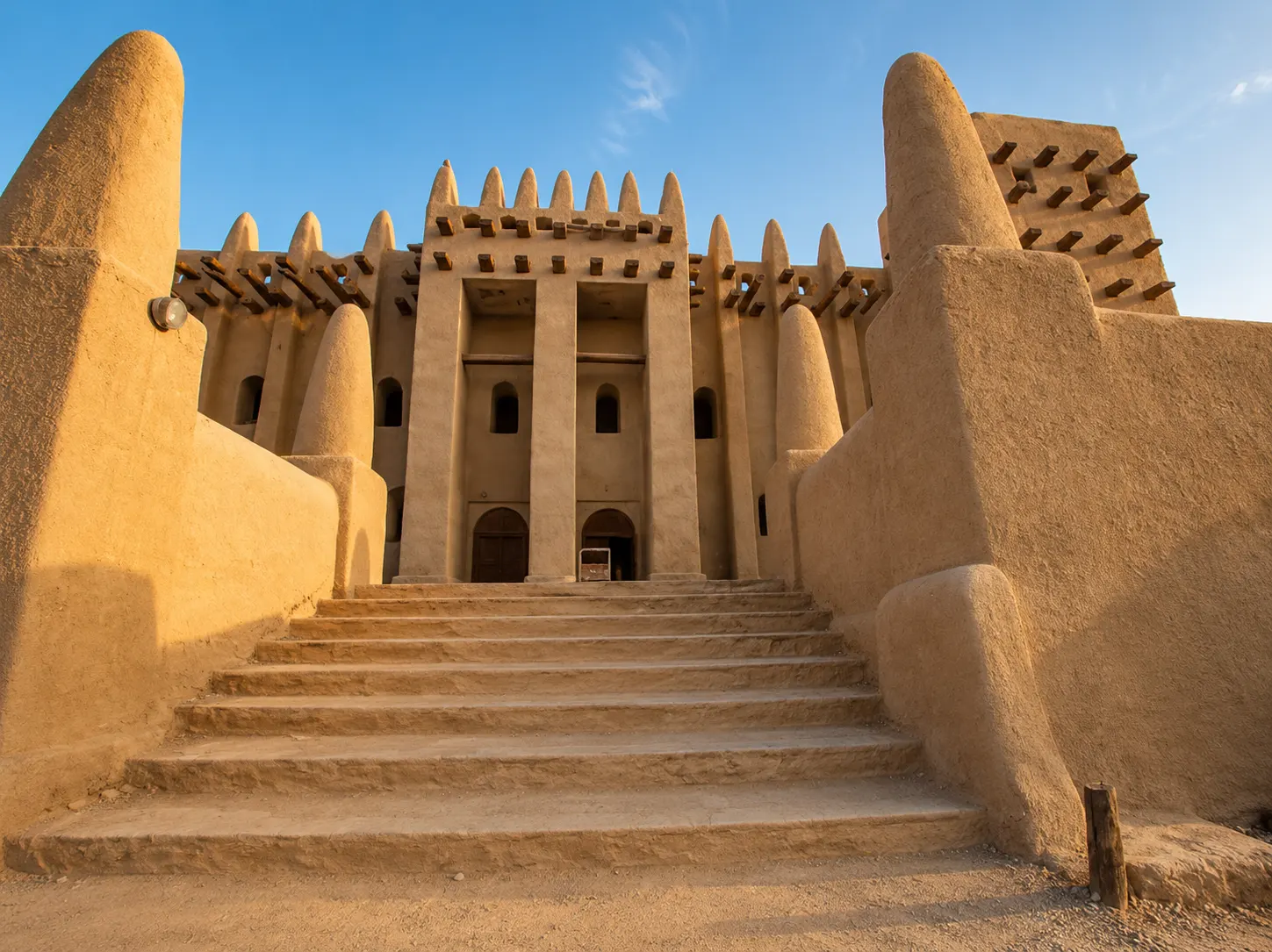
The largest adobe structure in the world is The Great Mosque of Djenné (Mali), demonstrating the long-lasting strength and practicality of adobe construction.

Both adobe and cob use locally available materials, provide excellent thermal insulation, reduce construction costs, and have a very low environmental impact.

Adobe Construction

Materials Required

Adobe uses locally available natural materials that are low cost and environmentally friendly.

Earth (Soil) — The primary ingredient. Use soil with good clay content for proper binding and brick strength.
Clay — Acts as the natural binder that holds the brick together and gives it strength when dried.
Sand — Reduces shrinkage and cracking during drying; provides structural strength to the brick.
Straw — Acts as natural fiber reinforcement, reducing cracking and adding tensile strength to the dried brick.
Water — Used to mix the materials into a workable consistency for molding into bricks.

Standard Adobe Brick Sizes

Typical Size: 10 × 4 × 14 inches
Larger Traditional Bricks: 6 × 12 × 24 inches

How to Make Adobe Bricks

Mix sand, clay, water, and straw together thoroughly until a consistent workable mixture is achieved.
Place the mixture into wooden molds of the desired brick size. Press firmly to ensure no air pockets.
Remove the bricks from the molds carefully and place them on a flat surface in the sun to dry.
Turn bricks onto their edges and air-dry for approximately four weeks until completely hardened.

Construction Process — Step by Step

Step 1 — Site Preparation — Clear all vegetation, grass, and organic matter. Level and compact the ground. Mark out the wall layout using limestone powder or string lines.
Step 2 — Foundation — Lay a solid foundation using stone, gravel, or concrete to lift the adobe walls above ground level. A minimum stem wall height of 1.5–2ft above ground is recommended to protect from rising damp.
Step 3 — Wall Construction — Lay adobe bricks in courses using earth mortar (same mix as the bricks but wetter). Stagger the joints between courses for structural strength. Typical walls are 12–24 inches thick.
Step 4 — Doors, Windows & Ventilators — Install wooden frames for doors and windows before or during wall construction. Use a solid timber or adobe arch lintel above all openings to distribute the load.
Step 5 — Roofing — Adobe walls require a good roof with wide overhangs (at least 2ft) to protect from rain. Common options include timber frame with clay tiles, corrugated metal sheets, or thatched roofing.
Step 6 — Plastering — Apply earth plaster, lime plaster, or gypsum plaster to both interior and exterior walls for weather resistance and a smooth finish.
Step 7 — Flooring — Compact the ground floor thoroughly. Apply a mix of fine clay and water as a base coat. Finish with linseed oil or a lime wash for a hard, smooth, natural surface.

Side by Side

Adobe vs COB — Comparison

Both methods are proven, sustainable, and low-cost. The right choice depends on your climate, available materials, and construction preference.

Feature Adobe COB
Construction MethodSun-dried bricksMonolithic hand-built walls
Wall FormationBrick masonryContinuous layered construction
DryingBricks dried before useWalls dry during construction
Design FlexibilityModerateVery High
Best ClimateWarm & DryModerate to Dry
Thermal PerformanceExcellentExcellent
SustainabilityVery HighVery High

Adobe and Cob are proven earth-based construction techniques that have served communities for centuries. Adobe is ideal where brick-based construction is preferred, whereas Cob offers greater architectural freedom with seamless monolithic walls. Selecting either method depends on climate, available materials, construction skills, and project requirements.